

Selecting the right forestry hydraulic log loader trailer requires matching the equipment to your operational environment, timber tonnage, and transport method. It is a decision that necessitates a comprehensive evaluation of three key components: the trailer chassis, the log loader, and the power system.
Step 1: Determine the trailer chassis and running gear
The trailer chassis is the foundation of the entire unit; it dictates where you can operate and how much weight you can haul.
Consider axles and load capacity: These are the most critical specifications. Forestry trailers typically range in load capacity from 3 to 15 tonnes.
Single-axle trailers: These have a relatively lower load capacity (e.g., models with a 3-tonne payload) but offer superior maneuverability, making them ideal for narrow forest trails or small-scale operations.
Dual-axle trailers: These offer higher load capacity and greater stability. For instance, some dual-axle trailers have a gross vehicle weight (GVW) of up to 15,000 kg, making them suitable for large-scale forestry operations and long-distance transport. When choosing, ensure the maximum permissible gross weight significantly exceeds the weight of the timber you typically transport.
Consider terrain adaptability:
If your work takes place primarily on flat terrain-such as established forest plantations, processing plants, or timber markets-a standard wheeled trailer will suffice.
If you need to operate in mountainous regions (such as in the south), or on muddy or uneven forest terrain, prioritize the trailer's off-road capability. Some high-end trailers feature hydraulic traction steering and auxiliary wheel drive systems (4WD), providing better traction and recovery capabilities in challenging terrain.
Consider the braking system: Braking is crucial for heavy-duty trailers. Common braking systems for forestry trailers include hydraulic and pneumatic (air) brakes. Your choice must be compatible with the braking system of your towing vehicle.
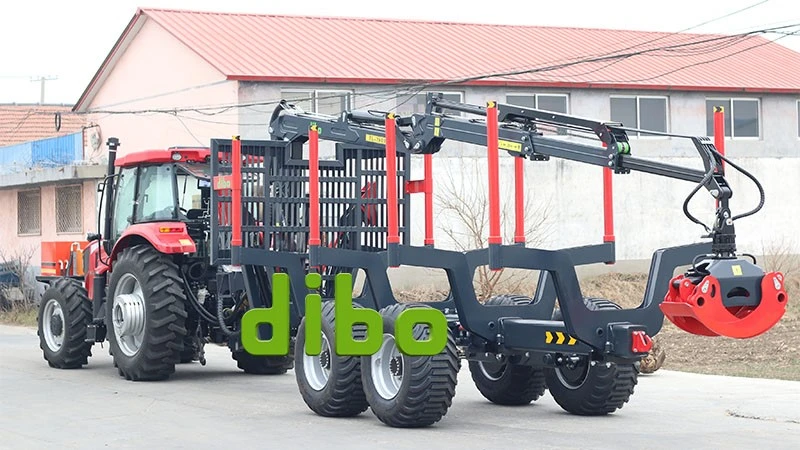
Step 2: Selecting the Right Timber Grapple (Crane)
The timber grapple acts as the "arm" mounted on the trailer; its operating range directly determines your loading and unloading efficiency.
Consider operating range and lifting capacity: When purchasing, first consider the height of the transport vehicles you will be using. For a standard 13-meter flatbed trailer, a grapple with a loading/unloading height exceeding 4.6 meters is sufficient. However, if you are loading or unloading high-sided trailers (over 9 meters long), the boom must be long enough to reach over the side rails, requiring a loading height of preferably over 5.1 meters.
Check crane specifications: The key factor is the lifting capacity at various boom lengths. For instance, a model with a 7-meter boom might lift 1 ton at full extension (7 meters), whereas a 7.8-meter model might only lift around 580 kg at that same distance. You should determine the required crane specifications based on the maximum weight of the timber and the necessary operating radius.
Grapple type and rotation: To handle various materials (such as raw logs, squared timber, or wood scraps), it is best to choose a model that supports interchangeable grapple attachments. Additionally, 360-degree or 370-degree grapple rotation is a standard feature that significantly enhances operational flexibility.
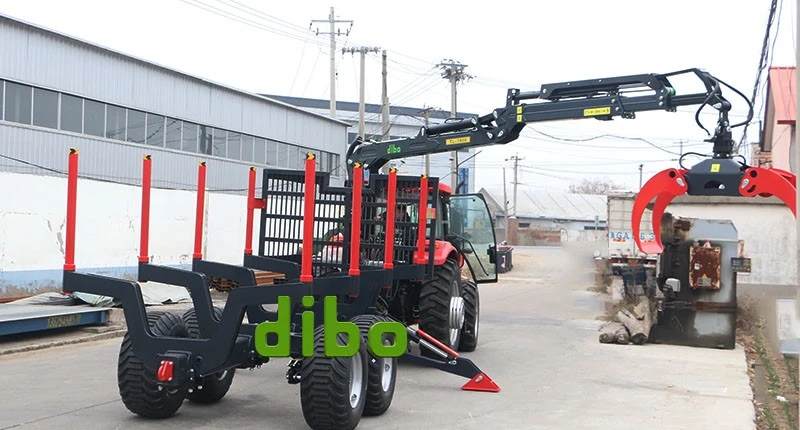
Step 3: Determine the Power Source and Operation Method
Consider the power system:
PTO (Power Take-Off) Drive: Powered by the towing tractor's engine; suitable for users who already own a large agricultural tractor.
Self-Contained Power Unit: The log loader comes with its own diesel engine or electric motor, offering high independence; it can be mounted on a truck or a specific trailer.
Consider the operation method: In addition to traditional manual hydraulic valves, many units now offer optional radio-controlled hydraulic systems. This allows the operator to step out of the cab and perform loading/unloading from the best vantage point, enhancing safety.
A Few Easily Overlooked Details
Structural strength is key: Forestry environments are harsh, and the trailer frame and crane boom are high-load components. Prioritize models with double-beam structures or thickened, reinforced designs; this forms the foundation for the equipment's durability and reliability.
Stabilizer legs are essential: During operation, hydraulic stabilizer legs are crucial for maintaining the vehicle's stability and effectively preventing tip-over accidents.
Safety features and compliance: Verify that the trailer is equipped with the full set of lights, reflective decals, and wheel fenders required for road travel.
The most reliable approach is to provide your core requirements-such as the operating environment, the type of timber being transported, and the maximum dimensions and weight-directly to a professional manufacturer so they can propose a tailored solution. Yantai Dibo Machinery Equipment Co., Ltd. specializes in forestry trailers, log loaders, grapple heads, hydraulic motors, and other forestry logging and transport equipment. Our products are CE certified and exported to over 50 countries, earning consistent praise from global distributors and forestry professionals alike. We are confident in providing you with a satisfactory solution and forestry machinery that exceeds your expectations.
